










Indonesia’s digital payments ecosystem is transforming the way businesses collect and distribute money. From online marketplaces to worldwide enterprises, businesses are using digital wallets for faster transactions. For businesses that handle both domestic and foreign payments, the Indonesian e-wallet sector is of particular relevance, as the use of GoPay, OVO, DANA and ShopeePay is on the rise.
Receiving money through digital wallets and sending compensation for business are two different things. Businesses need more than just a payment checkout. They need to have reliable disbursement infrastructure, transaction verification, transaction tracking, bulk processing and transparent settlements.
For businesses paying Indonesian vendors, employees, contractors or marketplace sellers, picking the correct payment infrastructure is important. This is where a single platform like TransFi makes it easy to collect locally and disburse across borders.
Understanding the E-Wallet Indonesia Market
Indonesia is one of the most active digital payment ecosystems in Southeast Asia. Retailers, e-commerce sites, transportation systems and online services have embraced mobile wallets.
As per Mordor Intelligence, the Indonesian mobile payments market is projected to expand from USD 48.39 billion in 2026 to USD 98.87 billion by 2031. This would represent a CAGR (compound annual growth rate) of 15.36%.
The rise is attributable to several factors:
- Rising use of smartphones: A greater number of people are adopting mobile apps for their day-to-day financial activities.
- Growth of e-commerce: The rise of internet shopping produced a desire for simple online payment mechanisms.
- QRIS adoption: Indonesia’s national QR payment standard enables cooperating payment apps.
- Digital financial services: Wallets are increasingly being utilised for bill payment, remittances, merchant payments and other financial services.
QRIS is particularly important for merchant acceptance. It enables clients to pay with a single QR code through partner bank apps and digital wallets.
Bank Indonesia sets a maximum QRIS transaction value of IDR 10 million per transaction. But that's a restriction that applies to QRIS, not a cap on every e-wallet transaction.
For businesses, this infrastructure offers the possibility to approach clients through the payment methods they know. But collecting payments is just one phase of the payment lifecycle. The ability to disburse is another question. Sending money to recipients is a different capability.
How Business Payouts Work Through Indonesian E-Wallets
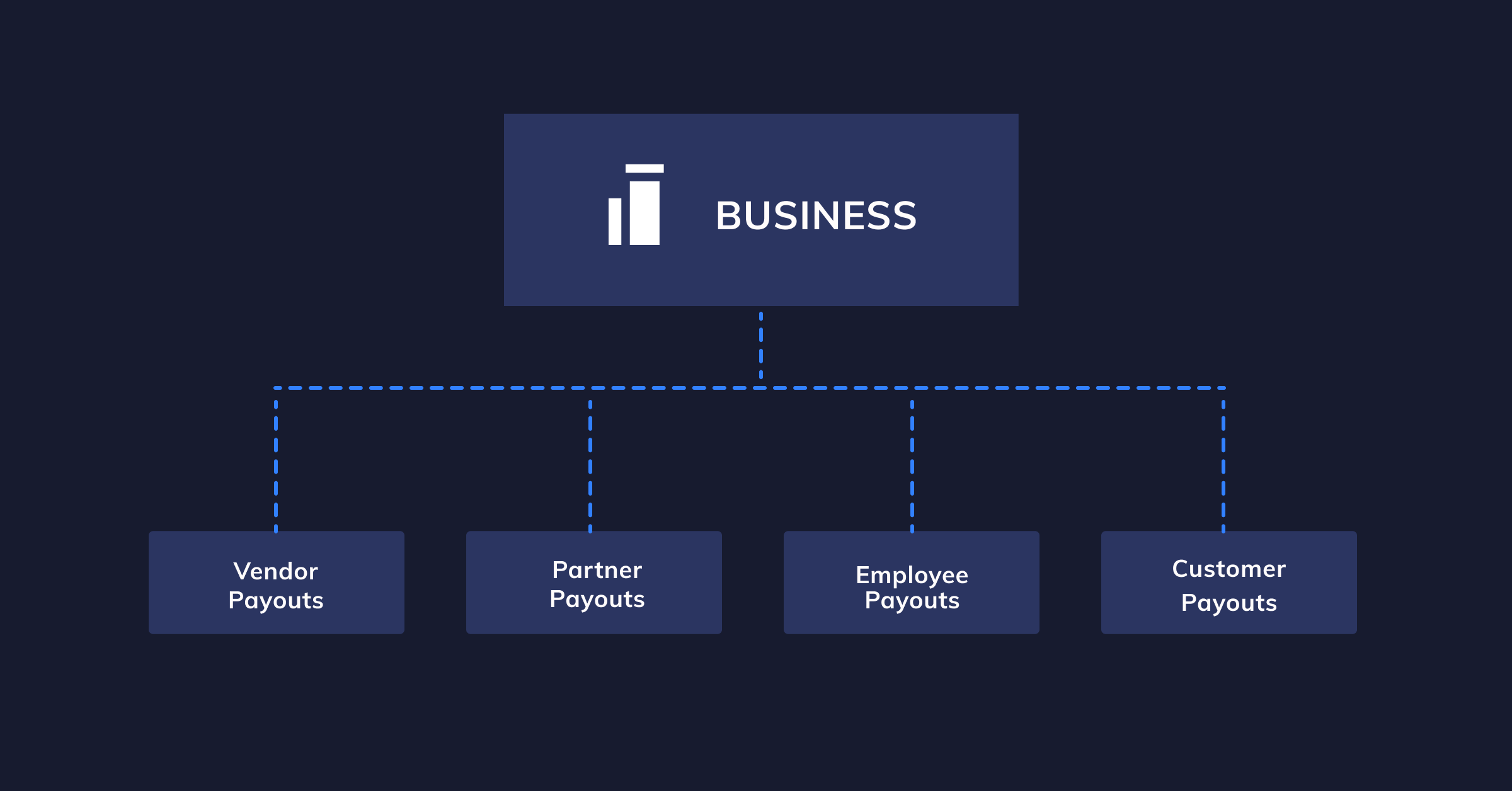
Business payments occur when one business sends money to another person or firm. These can be transactions:
- Pay and Allowances of Employees.
- Contractor and freelancer payments.
- Marketplace seller resolutions.
- Incentives and rebates for customer marketing.
- Vendor and supplier payments.
The standard payout flow is to identify the payee, check the account details, initiate the transfer and follow the status.
For firms with hundreds or thousands of recipients, completing these transactions, one at a time, is not an efficient method.
This feeds the demand for bulk payment e-wallet Indonesia solutions for automated transfers, transaction monitoring and reconciliation.
Crucially, firms need to separate four capabilities:
- Payment acceptance: Collecting money through an e-wallet.
- Merchant settlement: Transfer of collected payments to a merchant account or bank account.
- Refunds: Return of money to consumers after a transaction.
- Disbursement: Transfer funds to other bank accounts or digital wallets.
These functions are not the same. For example, a wallet that allows you to make payments to merchants does not always offer an API for direct business payouts.
How to Send Payments to GoPay, OVO, DANA and ShopeePay
Businesses usually integrate with Indonesian digital wallets through direct integrations or payment infrastructure providers.
The four wallets are significant players in the domestic payments ecosystem. However, the assessment of their business capabilities should be based on the actual payment flow.
GoPay: Merchant payments, QRIS acceptance and payment gateway integration. It also gives access to collected funds through its merchant services. That said, businesses should check with the relevant merchant API to see if the automated outbound payout workflow they want to use is supported.
OVO: OVO is commonly used for merchant transactions and digital payments. Its presence in the payment ecosystem makes it relevant for businesses that accept wallet payments. Direct corporate disbursement capabilities, API access and payout limits should be verified separately.
DANA: Of the four wallets, DANA has the most clearly documented disbursement functionality. Its API documentation lists automated transfers to Indonesian bank accounts and DANA balances. This is important for companies that have to make automated outgoing payments.
ShopeePay: It is a well-established digital payment option within the commerce ecosystem in Indonesia. But businesses should distinguish its ability to accept payments and settle merchants from direct third-party payout capability.
The complexity in development and operational aspects can rise when global businesses integrate each wallet separately.
This can be alleviated by a payment infrastructure provider that integrates a business with the supported local payment methods via a single integration.
TransFi: Simplifying Business Payments to Indonesia
In many cases, you will need to establish multiple banking relationships, integrate with local payment methods, and handle currency conversion to manage payments across different countries.
And this is where TransFi comes in with a unified payment infrastructure that connects businesses to local payment methods and cross-border financial rails.
Its Indonesia payment offering enables collections via GoPay, OVO, DANA, QRIS and Indonesian bank transfers with a single integration.
Businesses looking to understand the available payment methods and e-wallet payout coverage in Indonesia can explore TransFi's local payment infrastructure, including supported digital wallets and bank transfer options.
This enables international businesses to access payment methods that Indonesian customers already know.
For businesses making outbound payments, TransFi’s payout infrastructure offers payments to bank accounts and mobile wallets in its supported markets. It also documents individual and bulk payouts, recipient management, transaction monitoring and payment-status updates.
Some of the relevant capabilities include:
1. Single API integration
Businesses can access collections, payouts, and other payment capabilities through one API. This reduces the need to build and maintain separate integrations for different payment methods.
2. Dealing with bulk payments
A centralised workflow allows companies to deal with many recipients. The bulk payment tool from TransFi that allows for CSV uploads is a useful feature for firms that pay vendors, contractors or freelancers on a regular basis.
3. Recipient management and validation
Companies may gather the information of the recipient according to each country’s requirements. This can help avoid problems arising from improper account details or incomplete beneficiary details.
4. Transaction tracking and reconciliation
The tool allows businesses to check the progress of payments. Webhooks can give you automated updates when a transaction’s status changes, helping your finance teams handle payment exceptions and reconciliation.
5. Infrastructure for cross-border payments
TransFi enables payments to 70+ countries in 40+ currencies, leveraging local payment mechanisms and stablecoin infrastructure. This means worldwide enterprises can pay without having to set up a payment mechanism for each market.
For companies exploring business payments to Indonesia, this unified approach can simplify the operational challenges of entering a new market.
Businesses should check TransFi’s Indonesia payment methods and local payout coverage to determine which payment options are available.
E-Wallet vs Bank Transfer Indonesia: Which Is Better?
Both digital wallets and bank transfers serve key company payment demands. The right solution relies on the recipient, value of the transaction, frequency of payment and available payment infrastructure.
Digital wallets are especially useful if the recipients utilise mobile apps for their everyday transactions. They can also facilitate smaller, more frequent payments and digital commercial operations.
Bank transfers tend to be better for bigger payments to suppliers, for corporate transfers and for recipients who want their money paid straight into their bank accounts.
The distinction also functions on the operational level for foreign enterprises. Payout methods have varied costs, processing timeframes, recipient restrictions and transaction limits.
A single payments platform lets businesses select the correct payment rail for each transaction, instead of being restricted to one way for all.
Future Outlook for Business Payouts in Indonesia
The digital payment ecosystem in Indonesia is expected to become more integrated.
The use of QRIS, the spread of mobile wallets, and the infrastructure of real-time payments are making the business environment more accessible.
However, the next stage of development is to improve outbound payment infrastructure.
Marketplaces will need to mandate efficient seller settlements. International companies will need to rely on contractors for payments. Digital platforms will have to provide automatic refunds and distribution of incentives.
These needs will drive demand for payment infrastructure that combines local payment methods, bulk processing, transaction monitoring and cross-border settlement.
Platforms like TransFi can be a huge help, connecting businesses to local payment rails with one integration.
As Indonesia’s digital economy grows, companies facilitating collections and disbursements will be better positioned to grow across the market.
Conclusion
GoPay, OVO, DANA and ShopeePay are now integral to Indonesia’s digital payments ecosystem. However, businesses should consider their ability to pay out separately from accepting payments and merchant settlement.
DANA has clear documentation on disbursements for wallet and bank. Direct corporate payout features in other wallets need further verification.
For international businesses, the juggling of various local integrations may be an unwelcome complication. TransFi solves this problem by providing a single infrastructure for local collections, cross-border payments and supported payout methods.
Whether a company is paying vendors, contractors, employees, or marketplace sellers, choosing the right payment infrastructure can make it easier to manage and scale operations in Indonesia.
FAQs:
1. Which e-wallets are popular for business in Indonesia?
The main digital wallets in Indonesia include GoPay, OVO, DANA and ShopeePay. These payment methods are used by businesses to obtain merchant payments, internet transactions and other payment services they support.
2. How do I pay out to GoPay, OVO, DANA, and ShopeePay?
Businesses can opt for direct wallet integrations or use payment service providers that offer supported local payout methods. The amount of direct payouts may vary among providers and wallets. Always verify the recipient’s coverage and API capabilities before integration.
3. Can I send bulk payouts to e-wallets?
Yes. Businesses can use payout platforms that can handle bulk payouts. The platforms let companies manage multiple recipients, upload payment details, start transactions and monitor the status of those transactions.
4. What are the e-wallet transaction limits for businesses?
Transaction limits vary by wallet, account type, verification status and payment method. QRIS has a maximum transaction value of IDR 10 million per transaction. This limit should not be confused with transfer limits or individual wallet balance.
5. How long do e-wallet payouts take?
Different wallets, receiving institutions, payment rails and service providers all have different processing times. Some transfers will take minutes to complete, while others may take some extra processing time or confirmation.
6. E-wallet or bank transfer — which is better for disbursement?
E-wallets are useful for those who prefer to pay by mobile and for smaller transactions. Bank transfers are often the best way to make large business payments and payments to suppliers. It is contingent upon the recipient’s preferences, transaction limits and fees. Businesses should choose accordingly.
7. Are these e-wallets regulated by Bank Indonesia?
Payment service providers in Indonesia are subject to Bank Indonesia’s payment-system regulatory regime and applicable licensing requirements. Businesses should check the licensed entity and its activities under its licence that apply to them.
8. What fees apply to e-wallet payouts?
The fees depend on the payment provider, how you pay, the currency conversion and where the money goes. Businesses should consider transaction charges, FX margins and other processing expenses before choosing a provider.
9. How can businesses manage international payouts to Indonesia?
With cross-border payment infrastructure like TransFi, businesses can access the supported Indonesian payment methods. One platform can streamline collections, recipient management, currency conversion and outbound payments.
10. What should businesses consider before choosing an e-wallet payout provider?
Businesses should examine factors such as recipient coverage, API availability, transaction limits, processing times, fees, compliance needs, bulk payment capabilities, and reconciliation features. These are the things that determine whether or not a provider can enable commercial payments at scale.