










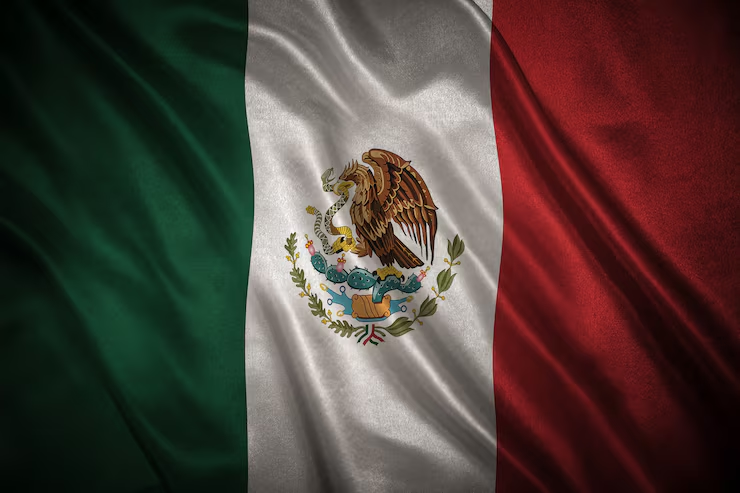
Mexico’s payment infrastructure is becoming global, and it's now one of the largest cross-border payment markets in the world.
The country receives billions of dollars annually through exports, international trade, digital services, freelancer income, foreign investment and remittance inflows.
As commerce becomes increasingly digital, businesses in Mexico are on the lookout for faster ways to receive international payments without relying on the same old and slow traditional banking rails.
Today, in Mexico, like the rest of the world, payment innovation is driven by local payment networks, digital-native fintechs, stablecoin settlement infrastructure, global liquidity rails and real-time payout systems. And the centre of attraction of Mexico’s banking system is SPEI.
Let’s decode how this local infrastructure can be leveraged in a smart way with the modern payment systems!
What is SPEI?
SPEI (Sistema de Pagos Electrónicos Interbancarios) is Mexico’s real-time interbanking payment infrastructure. It is often described as Mexico's core bank transfer rail.
It’s called so for a reason; it enables several advantages like
- instant bank transfers
- real-time settlements
- 24/7 payment processing
- low-cost domestic transfers
Presently, SPEI powers a significant portion of digital transactions across Mexico. For local payments, it's become the country’s financial backbone.
The Friction Traditional Cross-border Flows Create
International payments have always been more complicated than domestic transfers. Traditional cross-border transactions often consist of a sender bank, the correspondent bank, the regional intermediary and a recipient bank.
And this process eventually creates:
- Settlement delays
- higher transaction costs
- limited visibility
- compliance bottlenecks
- foreign exchange inefficiencies
For businesses receiving international revenue, these issues create a larger impact on cash flow, payroll, supplier payments and operational planning. Put together, these are a bundle of problems. That is why many businesses are exploring alternative forms of payment.
The Rise of Digital-Native Fintechs
Over the past decade, it's the digital-native fintechs that have designed the movement of money across borders.
Because of this, instead of relying on traditional banking networks, modern payment providers increasingly utilise the following:
- local payout infrastructure
- API-driven settlements
- automated compliance workflows
- global liquidity rails
As a result, the payment experience is invariably smoother for businesses receiving international funds. And for many companies, the goal is simple and clear: they want to move money globally while delivering funds locally as fast as possible.
The Cross-Border Payment Network and Stablecoins
Stablecoins are now becoming a part of international payment infrastructures as they offer something better than traditional banks do. Unlike traditional banking that depends on multiple intermediaries, stablecoin-powered settlement options can support
- Faster settlement
- Global accessibility
- Programmable payments
- Treasury flexibility
- Improved liquidity management
This is why discussions around stablecoin usage and remittances are becoming increasingly relevant for businesses operating internationally.
So, stablecoins are not really replacing banking infrastructures but are being used alongside and on top of local payment infrastructures.
The Powerful combination of SPEI and Stablecoins
The most interesting development is not SPEI alone. It is the powerful blend of stablecoin settlement, SPEI disbursement, local banking infrastructure and modern payment orchestration.
And how do these work together? Let’s understand that with an example.
A business in the US may initiate a cross-border payment, and the settlement can occur through modern payment infrastructure. Funds are then routed locally through SPEI, which in turn enables local delivery to the recipients in Mexico.
This approach helps businesses improve settlement speed while maintaining local payout convenience. For a deeper exploration of this very model, read one here.
USDT Payout and Collection in Mexico SPEI and Banorte
Using TransFi BizPay for Business Payouts
As these cross-border ecosystems grow, businesses need infrastructure that supports both global and local collections and settlements. TransFi BizPay comes into the picture here.
Instead of manually setting up and coordinating with multiple providers, businesses can use BizPay to;
- simplify international collections
- support SPEI-compatible payouts
- streamline cross-border settlements
- improve payment visibility
- reduce operational friction
- support multi-currency payment workflows
Businesses looking to receive international payments actively need systems that bring them the best of global and local payment ecosystems.
Mexico's Banking Ecosystem Supports Local Settlements
Mexico’s financial ecosystem includes several major institutions that support modern payment processing and upcoming settlement infrastructures. Popular institutions include the following:
These institutions play an important role in connecting international payments with domestic infrastructure and will continue doing so.
OXXO, SPEI and Cards
Mexico’s payment ecosystem is unique and strong because multiple payment institutions co-exist.
Consumers and businesses regularly use.
- SPEI transfers
- card payments
- cash-based payment points like OXXO
- digital wallets
- fintech payment apps
Together, they signal a very important trend in Mexico, where it's becoming a multi-rail payment economy. And businesses too expect systems which cater to all their payment needs, whether domestic or international.
Online Payment Processors in Mexico
It's very clear that the growth of international commerce has increased the demand for modern payment infrastructures.
Online payment processors in Mexico presently extensively support it.
- local bank transfers
- SPEI integration
- international collections
- API-based payment workflows
- multi-currency settlements
This becomes really useful and important for exporters, SaaS businesses, marketplaces, fintech companies and global service providers.
One thing to note while committing to international payment is the foreign exchange efficiency and the exchange rate. Monitoring Mexico’s live exchange rate can help businesses better understand the actual gains of their transfers and track the money lost.
Conclusion
Whether businesses need to send money to Mexico or receive money from Mexico, the backbone remains the same: faster settlements, better visibility and transparency, as well as lower operational friction.
To achieve this, Mexico's payment ecosystem is evolving rapidly through the combination of SPEI, modern fintech infrastructure, and stablecoin-powered settlement systems. Infrastructures bringing them together, like TransFi BizPay, help power up these systems all in one place, with a simplified user experience and global integration capabilities.
And for businesses receiving international payments, these innovations are directly helping and shaping how Mexico deals with international as well as local payment rails.
Explore the possibilities of integration and growth with TransFi Bizpay to embrace the innovation the world is moving towards.
FAQs
1. What is SPEI?
SPEI (Sistema de Pagos Electrónicos Interbancarios) is Mexico’s real-time interbanking payment infrastructure. It is often described as Mexico's core bank transfer rail.
2. What payment methods are popular in Mexico?
SPEI, card payments, OXXO cash payments, bank transfers, and digital wallets are widely used.
3. Can businesses receive international payments through SPEI?
Yes, modern payment providers can integrate international settlements with SPEI-based payouts, enabling local collections.
4. How can businesses simplify international payouts to Mexico?
Businesses can use platforms like TransFi BizPay to streamline collections, local as well as international settlements.






.avif)
.avif)



.avif)